Choosing the right certification can determine whether an LED product reaches a market smoothly or stops at customs. Buyers, importers, and manufacturers often ask, “what certifications are required for led lighting products?” The answer depends on the destination country, product type, voltage, wireless functions, and installation environment. A residential bulb, outdoor floodlight, and industrial high-bay fixture may follow different compliance paths. The label is only one visible detail. Test reports, technical files, supplier records, and production controls matter too.
This guide presents seven practical tips for evaluating LED certifications with greater confidence. It examines common requirements such as CE, UKCA, UL, ETL, FCC, RoHS, EMC, and photobiological safety testing. Not every product needs every mark. That assumption causes expensive mistakes. A product with an integrated driver may require different testing from a low-voltage strip light. Wireless controls can add radio-frequency obligations. Outdoor products may also need evidence for water and dust resistance.
Look closely at the details. Check the certificate holder, model number, input rating, testing standard, and expiration status. A familiar logo does not prove compliance. Neither does a supplier’s simple PDF. In practical reviews, mismatched model numbers and incomplete lab reports appear more often than expected. Some guidance also changes as standards are updated, so this article cannot replace advice from an accredited laboratory or local authority. Still, careful questions can expose weak documentation early. Small checks matter. The goal is not to collect impressive certificates, but to confirm that each claim matches the actual LED product, market, and intended use.
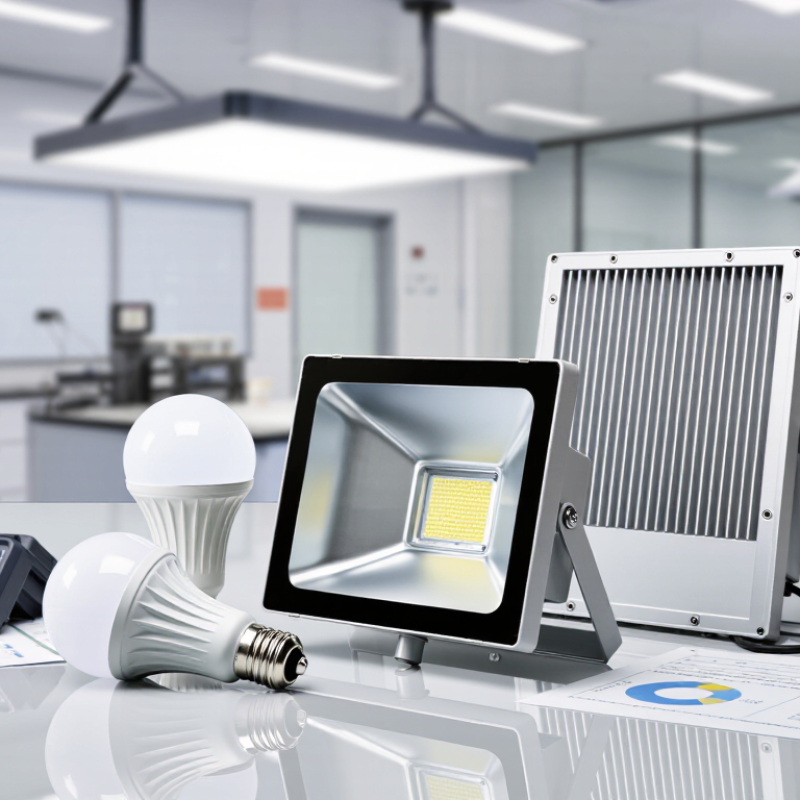
LED product certification confirms that a lamp, module, or fixture meets defined safety and performance requirements. Its purpose is practical: reduce shock, fire, overheating, electromagnetic interference, and excessive optical exposure risks. It also gives buyers traceable evidence before installation. Not every LED product needs the same certificate.
The required scope depends on the product design, voltage, wireless functions, installation environment, and destination market. Common evaluations include electrical safety, electromagnetic compatibility, energy performance, photobiological safety, and restricted substances. Wireless LED products may need additional radio testing. A low-voltage strip and a mains-powered floodlight should never share one compliance assumption.
A reliable process begins with the final design, not the finished carton. Engineers should review circuit diagrams, power supplies, enclosure materials, thermal paths, labels, and user instructions. Accredited laboratories can test representative samples and issue technical reports. The manufacturer may also need a declaration of conformity, registration, or market-specific marking. Requirements change, and online checklists can be incomplete. That is easy to miss. Keep test reports, component records, production controls, and corrective-action notes together. I have seen small label errors delay otherwise acceptable products. Rechecking the installation conditions is also wise, especially for outdoor, damp, or enclosed fixtures. Certification supports compliance, but it does not replace responsible design or ongoing production checks.
7 Tips: What Certifications Are Required for LED Products?
How to Identify Certifications by LED Product Type and Market
Tip 1: Match the certificate to the product’s function. An LED bulb usually needs electrical safety, electromagnetic compatibility, and energy-efficiency evidence. A complete luminaire may require additional photometric, thermal, and ingress protection testing. An outdoor floodlight faces different risks from an indoor decorative lamp. The product category matters.
Tip 2: Identify the destination market before testing. Requirements can change between North America, Europe, Asia, and the Middle East. Some markets accept recognized conformity marks, while others require local registration or specific energy labels. Do not treat one certificate as a global passport. That assumption often causes delays.
Tip 3: Review the complete technical file. Check the test report number, product model, rated voltage, driver details, and laboratory accreditation. A report covering one driver may not cover a revised driver. Small changes matter. I have seen projects delayed because the label showed a different model than the report.
Smart LED products may need radio, cybersecurity, and wireless compliance checks. Emergency lighting can require battery and duration testing. LED strips may need separate assessment for power supplies, connectors, and installation conditions. Ask the laboratory for a written scope before production. It feels slower, but it prevents expensive rework. Requirements also change, and older certificates may need review.
7 Tips: What Certifications Are Required for LED Products?
Electrical safety certification begins with the product category and installation environment. LED lamps commonly require IEC 62560, while complete fixtures are assessed under IEC 60598-1 and relevant national versions. In North American markets, UL 8750 may apply to LED components and luminaires. These standards examine insulation, electric shock protection, abnormal operation, temperature rise, and mechanical safety. The International Energy Agency reports that lighting uses about 15% of global electricity. Small safety failures can therefore affect millions of installations.
Check the certificate’s scope carefully. It should list the exact model, input voltage, driver, enclosure, and operating temperature. A certificate for an LED module does not automatically cover the finished fixture. Test reports should also show dielectric strength, leakage current, grounding continuity, and resistance to fire. Look for independent laboratory accreditation under ISO/IEC 17025. That detail matters.
Market access may also require electrical safety and electromagnetic compatibility compliance. In Europe, manufacturers commonly address the Low Voltage Directive and EMC Directive through applicable EN standards. The U.S. Department of Energy’s solid-state lighting reports show commercial LED products exceeding 150 lumens per watt in several applications. Efficiency is impressive, but it does not prove safety. I have seen specifications that look complete, yet omit driver certification or thermal test conditions. Recheck the paperwork. A certificate is evidence, not a lifetime guarantee.
| Tip | Market or Product Situation | Typical Requirement | Relevant Standards or Regulations | Usually Required? | Important Compliance Evidence |
|---|---|---|---|---|---|
| 1 | European Union and European Economic Area | Apply the CE conformity-assessment process before placing LED lamps or luminaires on the market. |
Low Voltage Directive 2014/35/EU; EMC Directive 2014/30/EU; RoHS Directive 2011/65/EU; EN 60598 series for luminaires; EN 62560 for self-ballasted LED lamps. |
Required by law when applicable CE marking is generally based on the manufacturer’s declaration of conformity; an independent certificate is not automatically required for every product. |
Technical file, risk assessment, test reports, EU Declaration of Conformity, product label, installation instructions, and records supporting restricted-substance compliance. |
| 2 | United States and Canada | Meet the applicable national electrical safety requirements and obtain access approval accepted by the authority having jurisdiction, distributor, or installation site. |
ANSI/UL 1598 for luminaires; ANSI/UL 1993 for self-ballasted lamps; ANSI/UL 8750 for LED equipment; CSA C22.2 No. 250.0 for Canadian luminaires; National and Canadian electrical installation codes. |
Conditionally required The exact listing, certification, or field-evaluation route depends on product type, jurisdiction, application, and purchaser requirements. |
Safety evaluation report, construction review, electrical and thermal test results, markings, wiring diagrams, critical-component information, and certification or field-evaluation documentation where requested. |
| 3 | United Kingdom | Use the applicable UK product-conformity route for electrical safety, electromagnetic compatibility, and hazardous-substance restrictions. |
Electrical Equipment (Safety) Regulations 2016; Electromagnetic Compatibility Regulations 2016; Restriction of Hazardous Substances Regulations; BS EN 60598 series; BS EN 62560 where applicable. |
Required by law when applicable Use UKCA or another legally accepted marking route according to the current product rules and market-recognition provisions. |
UK Declaration of Conformity, technical documentation, applicable test reports, product marking, traceability details, instructions, and importer or manufacturer information. |
| 4 | Australia and New Zealand | Meet the electrical-equipment safety and electromagnetic-compatibility requirements and use the required market-access marking. |
AS/NZS 60598 series for luminaires; AS/NZS 62560 for self-ballasted LED lamps where applicable; Electrical safety laws of the relevant jurisdiction; EMC requirements under the applicable regulatory framework. |
Required by law when applicable RCM registration and marking may be required for regulated electrical equipment; obligations can vary by product category and jurisdiction. |
Supplier declaration, safety and EMC test reports, registration details where applicable, product label, installation instructions, and evidence of conformity with the applicable standard. |
| 5 | Photobiological safety for LED light sources and fixtures | Assess optical radiation risks, particularly blue-light exposure, ultraviolet emissions, infrared emissions, and accessible radiation during normal use or foreseeable misuse. |
IEC/EN 62471 for photobiological safety of lamps and lamp systems; IEC/TR 62778 for blue-light hazard assessment of light sources and luminaires. |
Required when triggered by the product design or destination rules It is especially relevant for high-intensity, narrow-beam, exposed, medical, industrial, or close-range lighting products. |
Photobiological test report, risk-group classification where applicable, safety distance information, user instructions, optical design records, and warning labels if required. |
| 6 | Electromagnetic compatibility and radio-frequency behavior | Verify that the LED driver and fixture do not create excessive electromagnetic interference and remain sufficiently immune to expected disturbances. |
CISPR 15 or equivalent regional emission requirements; IEC/EN 55015 for lighting equipment; IEC/EN 61547 for immunity of lighting equipment; FCC Part 15 for applicable unintentional radiators in the United States. |
Required in most regulated markets EMC compliance is separate from electrical shock, fire, and mechanical safety evaluation. |
Radiated and conducted-emission results, immunity test results, harmonics and flicker data where applicable, wiring configuration, test samples, and conformity documentation. |
| 7 | Energy efficiency, environmental claims, and product performance | Check whether the destination market regulates energy performance, standby power, efficiency, durability, hazardous substances, or recycling information. |
Ecodesign and energy-labelling rules where applicable; RoHS requirements in regulated markets; IEC 62612 for performance requirements of self-ballasted LED lamps; IEC 62722 series for luminaire performance; Applicable packaging, waste, and recycling obligations. |
Market- and product-dependent Energy-efficiency labels or voluntary efficiency certifications may be required by a retailer, tender, rebate program, or building specification even when not generally mandatory by law. |
Electrical performance report, lumen-maintenance data, power-factor and standby-power results, energy-label documentation, material declarations, recycling information, and substantiation for all marketing claims. |
7 Tips: What Certifications Are Required for LED Products?
Tip 1: Start with EMC testing. LED drivers can create conducted and radiated interference. Test against CISPR 15 and IEC 61547, then verify harmonic current limits under IEC 61000-3-2. Tip 2: Check immunity, not only emissions. A lamp that passes in a quiet laboratory may flicker near motors or radio equipment. Tip 3: Keep test reports traceable. Record the driver model, LED board, wiring length, and operating temperature. Small changes can invalidate earlier results.
Tip 4: Confirm energy-efficiency rules for the target market. The U.S. Department of Energy reports that LED lighting can use at least 75% less energy than incandescent lighting. The International Energy Agency has also reported that lighting represents about 15% of global electricity consumption. Tip 5: Measure real performance, including standby power, efficacy, power factor, and lumen maintenance. A high initial lumen figure can hide rapid depreciation. Tip 6: Review environmental obligations. European requirements may involve hazardous-substance restrictions, waste collection, chemical disclosures, and product registration. RoHS and WEEE documentation should match the exact product configuration.
Tip 7: Build a technical file before shipment. Include declarations, safety tests, EMC evidence, energy data, material statements, and user instructions. An experienced compliance engineer will also check labeling and regional language requirements. I have seen projects delayed by one missing supplier declaration. The process is rarely perfect. Recheck every revision.
Seven practical controls reduce surprises in LED product approval. Test electrical safety against IEC 60598-1, driver requirements against IEC 61347, and photobiological risk against IEC 62471. Check EMC performance under CISPR 15 and IEC 61547. Test the complete luminaire, not only its LED module. Thermal measurements should reflect real installation conditions, including ceiling clearance and ambient temperature. Record component revisions, wiring diagrams, firmware versions, and calibrated instrument details. These small records often decide whether a file is trusted.
Documentation must match the shipped product. Keep test reports, declarations, labels, user instructions, risk assessments, and supplier evidence in one controlled file. Market access may also require energy, chemical, recycling, or radio-related documentation, depending on the destination. The UNEP 2023 Global Status Report states that buildings consume about 32% of global energy and create roughly 34% of global carbon emissions. Efficient lighting therefore faces high expectations, not just basic safety checks. Certification renewal dates should be tracked by model, factory, and market. Do not assume approval remains valid after changing a driver or diffuser. I have seen teams overlook a minor component change. That “minor” change can alter heat, EMC, or glare results. A pre-shipment audit, label review, and sample retest provide practical protection. Still, certification is not permanent market permission; local rules and technical files require periodic review.
It usually needs electrical safety, electromagnetic compatibility, and energy-efficiency evidence. Requirements depend on the destination market.
No. A certificate is not a global passport. Product function and market rules can differ widely.
It may need photometric, thermal, and ingress protection testing. An outdoor floodlight faces rain and dust risks that indoor lamps avoid.
Check the model, rated voltage, driver, LED board, and report number. A changed driver may require new testing.
They may need radio, wireless, and cybersecurity compliance checks. Firmware changes can create overlooked risks.
Battery performance and operating duration usually need verification. Record the test conditions carefully. Real failures happen.
Test emissions and immunity, not emissions alone. Drivers can disturb nearby equipment or flicker near motors.
Measure efficacy, standby power, power factor, and lumen maintenance. Initial brightness can look impressive, then decline quickly.
Prepare safety tests, EMC reports, energy data, material statements, declarations, labels, and instructions. Check regional language requirements.
Some markets require hazardous-substance, waste-collection, chemical, and product-registration records. Match every document to the exact configuration.
Understanding what certifications are required for led lighting products is essential for safe, compliant, and successful market entry. Certification needs depend on the product type, electrical design, installation method, and target market. LED lamps, bulbs, drivers, panels, and complete fixtures may require different evaluations, including electrical safety testing for protection against shock, overheating, fire, and mechanical risks. Identifying the destination market early helps manufacturers determine the applicable certification pathway and avoid unnecessary delays.
In addition to safety, LED products may need electromagnetic compatibility testing, energy-efficiency verification, and environmental compliance documentation. A complete compliance process normally includes product testing, technical files, labeling information, user instructions, declarations, and quality-control records. Certifications may also require periodic renewal, factory inspections, or updated testing when the product design changes. By organizing accurate documentation and monitoring certification validity, manufacturers can support reliable market access while demonstrating product performance, safety, and environmental responsibility.

Lume Light